Your skin is more than just a surface — it’s your body’s first line of defence against the outside world. At the heart of healthy skin lies a protective layer called the skin barrier (technically the stratum corneum), a thin but mighty shield made up of skin cells and lipids that keeps moisture in and irritants, bacteria, and pollutants out.
When this barrier is compromised, everything goes haywire — dryness, redness, breakouts, and sensitivity can spiral out of control. The good news? Once you identify the problem, learning how to repair skin barrier health is entirely possible with the right approach.
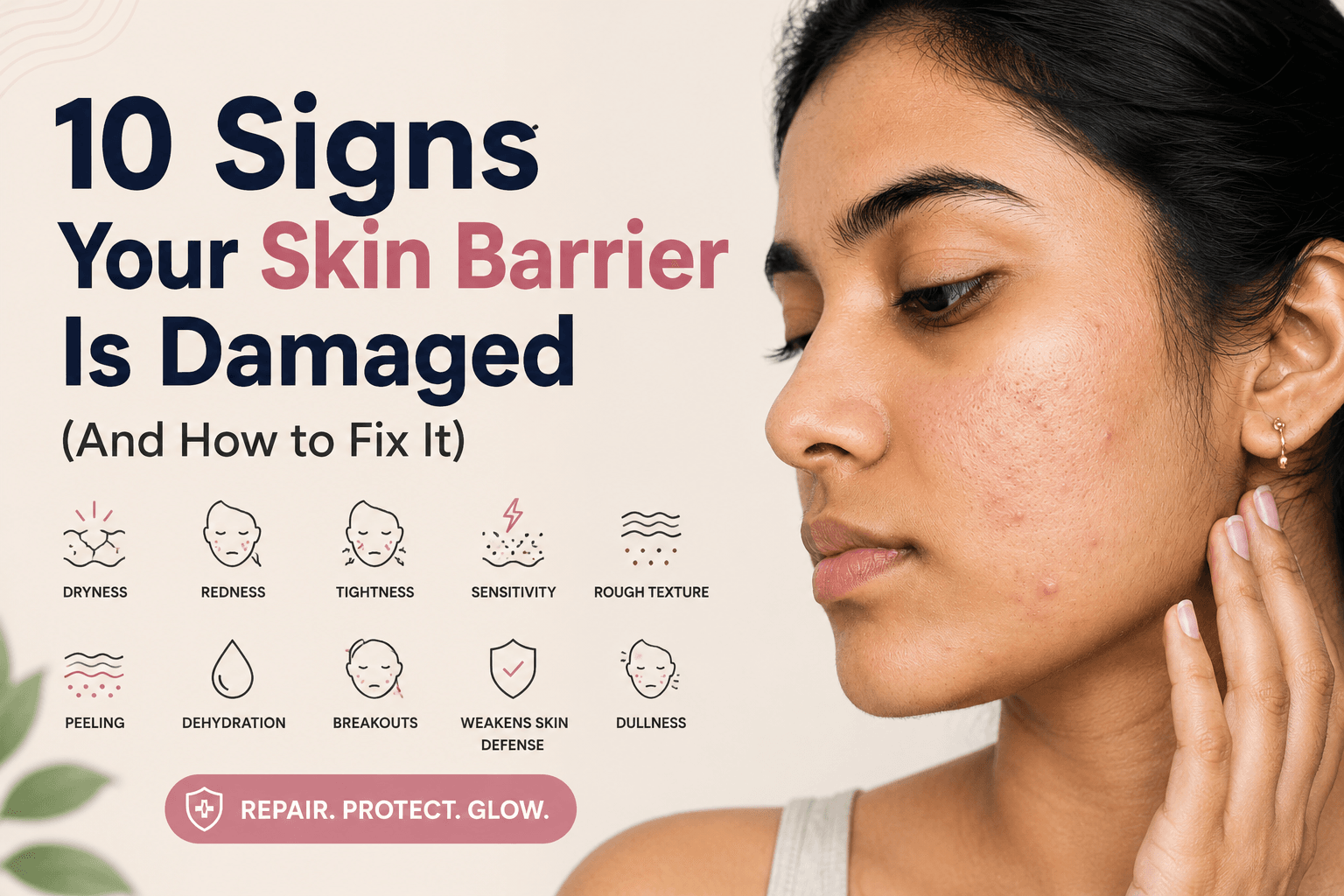
- 10 Signs Your Skin Barrier Is Damaged
- 1. Persistent Dryness and Tightness
- 2. Increased Sensitivity and Stinging
- 3. Redness and Inflammation
- 4. Flakiness and Rough Texture
- 5. Acne and Breakouts (Even on Dry Skin)
- 6. Itchiness Without an Obvious Cause
- 7. Dullness and Uneven Skin Tone
- 8. Oiliness in Some Areas, Dryness in Others
- 9. Eczema-Like Patches
- 10. Your Usual Products Suddenly Stop Working
- How to Repair Skin Barrier: A Step-by-Step Guide
- How Long Does Recovery Take?
- FAQs About Skin Barrier Damage
- Final Thoughts
10 Signs Your Skin Barrier Is Damaged
1. Persistent Dryness and Tightness
If your skin feels dry and tight even after applying moisturiser, it’s a classic red flag. A damaged barrier cannot retain water effectively, leading to transepidermal water loss (TEWL) — a measurable sign that your skin is losing moisture faster than it can hold it.
2. Increased Sensitivity and Stinging
Does your toner or serum suddenly sting or burn? When the barrier is intact, it filters out irritants. When it’s compromised, even gentle products can penetrate too deeply and trigger a reaction.
3. Redness and Inflammation
Chronic low-grade redness, especially around the cheeks and nose, often signals that the skin barrier is failing to keep inflammatory triggers at bay. This can worsen conditions like rosacea.
4. Flakiness and Rough Texture
Flaking or peeling skin — not caused by sunburn — indicates that the skin’s natural cell renewal process has been disrupted. Dead cells accumulate on the surface because the barrier isn’t functioning properly.
5. Acne and Breakouts (Even on Dry Skin)
A compromised barrier allows bacteria and pollutants to enter the skin more easily, increasing the risk of breakouts. Paradoxically, people with dry skin can also experience acne when their barrier is damaged.
6. Itchiness Without an Obvious Cause
Unexplained itching — especially when it’s widespread and not linked to an allergy — can be a sign that nerve endings are reacting to environmental triggers that the barrier would normally block.
7. Dullness and Uneven Skin Tone
A healthy barrier reflects light evenly, giving skin a natural glow. When it’s damaged, the surface becomes irregular, leading to a flat, lacklustre complexion that doesn’t respond well to makeup or skincare.
8. Oiliness in Some Areas, Dryness in Others
Oily in the T-zone but dry and flaky elsewhere — this is a common sign of barrier dysfunction. The skin overproduces oil in some areas to compensate for moisture loss, while other zones remain parched.
9. Eczema-Like Patches
Conditions like eczema (atopic dermatitis) are directly linked to a weakened skin barrier. Dry, scaly, or intensely itchy patches — especially in the folds of the elbows or knees — warrant a dermatologist’s assessment.
10. Your Usual Products Suddenly Stop Working
When a once-reliable moisturiser or cleanser starts causing irritation or delivers no results, your barrier may have changed. A damaged barrier alters how the skin absorbs and responds to ingredients.
How to Repair Skin Barrier: A Step-by-Step Guide
Understanding how to repair skin barrier damage doesn’t require an overhaul — it requires consistency and the right ingredients.
Step 1: Simplify Your Routine
Strip back to the basics: a gentle cleanser, a barrier-repairing moisturiser, and SPF. Pause exfoliating acids (AHAs/BHAs), retinoids, and alcohol-based toners until your skin recovers. Over-exfoliation is one of the most common causes of barrier damage.
Step 2: Use Ceramide-Rich Moisturisers
Ceramides are lipids that naturally make up about 50% of the skin barrier. Research shows that products combining ceramides, cholesterol, and fatty acids in a physiological ratio are most effective for skin barrier repair. Look for these three on ingredient labels.
Step 3: Layer Humectants Then Occlusives
Apply a humectant like hyaluronic acid or glycerin on damp skin to attract moisture, then seal it with an occlusive — petrolatum, squalane, or shea butter — to prevent water loss.
Step 4: Switch to Lukewarm Water and Gentle Cleansers
Hot water and sulphate-heavy soaps strip the skin’s natural lipids. Use lukewarm water and a fragrance-free, pH-balanced cleanser (ideally pH 4.5–5.5) to preserve the acid mantle.
Step 5: Never Skip Sunscreen
UV radiation degrades the lipids and proteins of the skin barrier. A broad-spectrum SPF 30 or higher every morning is one of the most evidence-backed steps for both protecting and healing your barrier.
Step 6: Seek Professional Treatment When Needed
For persistent or severe barrier dysfunction — including chronic eczema, recurring rosacea flares, or stubborn sensitivity — professional dermatological care is the most reliable path forward. People looking for skin barrier repair treatment in Kochi have access to board-certified dermatologists who offer evidence-based protocols such as prescription barrier creams, medical-grade moisturisers, and procedural treatments customised to the local climate and individual skin types.
How Long Does Recovery Take?
With consistent care, mild barrier damage often shows visible improvement within 2–4 weeks. More significant or chronic damage — such as that associated with eczema — may take 2–3 months. The key is patience and avoiding the temptation to reintroduce actives too quickly.
FAQs About Skin Barrier Damage
Q1: What are the most common causes of skin barrier damage?
The leading causes include over-exfoliation, harsh or fragranced cleansers, prolonged sun exposure without SPF, low-humidity environments, very hot showers, chronic stress, poor sleep, and using multiple active ingredients simultaneously (such as retinoids and AHAs together). Genetic conditions like atopic eczema also structurally impair barrier function from birth.
Q2: Can I repair my skin barrier at home, or should I see a dermatologist?
Mild damage often responds well to a simplified, ceramide-focused home routine. However, if you are experiencing chronic redness, eczema flare-ups, or sensitivity that doesn’t improve after 4–6 weeks of gentle skincare, a dermatologist’s evaluation is strongly recommended. For those in Kerala, clinics offering skin barrier repair treatment in Kochi provide personalised medical-grade care, including topical prescriptions and in-clinic therapies.
Q3: Is niacinamide effective for skin barrier repair?
Yes. Niacinamide (Vitamin B3) is one of the best-studied ingredients for skin barrier repair. Clinical research confirms it stimulates ceramide synthesis, reduces inflammation, helps regulate sebum production, and minimises the appearance of pores. It is well-tolerated across all skin types and can be used daily.
Q4: Can a damaged skin barrier cause acne?
Yes. When the barrier is compromised, Cutibacterium acnes — the bacteria associated with acne — and environmental pollutants can penetrate more easily, triggering inflammation and clogged pores. Many people find that addressing barrier damage significantly reduces the frequency and severity of breakouts.
Q5: How will I know when my skin barrier has fully recovered?
Your barrier has likely recovered when your skin no longer stings or reacts to gentle products, feels consistently hydrated throughout the day, has a smoother and more even texture, and shows reduced redness and sensitivity. A reliable test is the gradual reintroduction of mild actives like Vitamin C or a low-strength AHA — if your skin tolerates them without irritation, that’s a strong sign your barrier is healthy again.
Final Thoughts
Your skin barrier works silently every day to shield you from the environment, hold in hydration, and keep irritants out. When it’s damaged, virtually every skin concern becomes harder to manage. By recognising the early warning signs and knowing how to repair skin barrier health with gentle, clinically supported steps, you give your skin the best foundation to heal and thrive.
For those who need more than a DIY fix, professional support is available. Specialists providing skin barrier repair treatment in Kochi combine the latest dermatological science with an understanding of skin challenges specific to the humid, tropical climate of Kerala — helping you achieve lasting results safely.
Disclaimer: This blog is for informational purposes only and is not a substitute for professional medical advice, diagnosis, or treatment. Please consult a qualified dermatologist for personalised guidance.