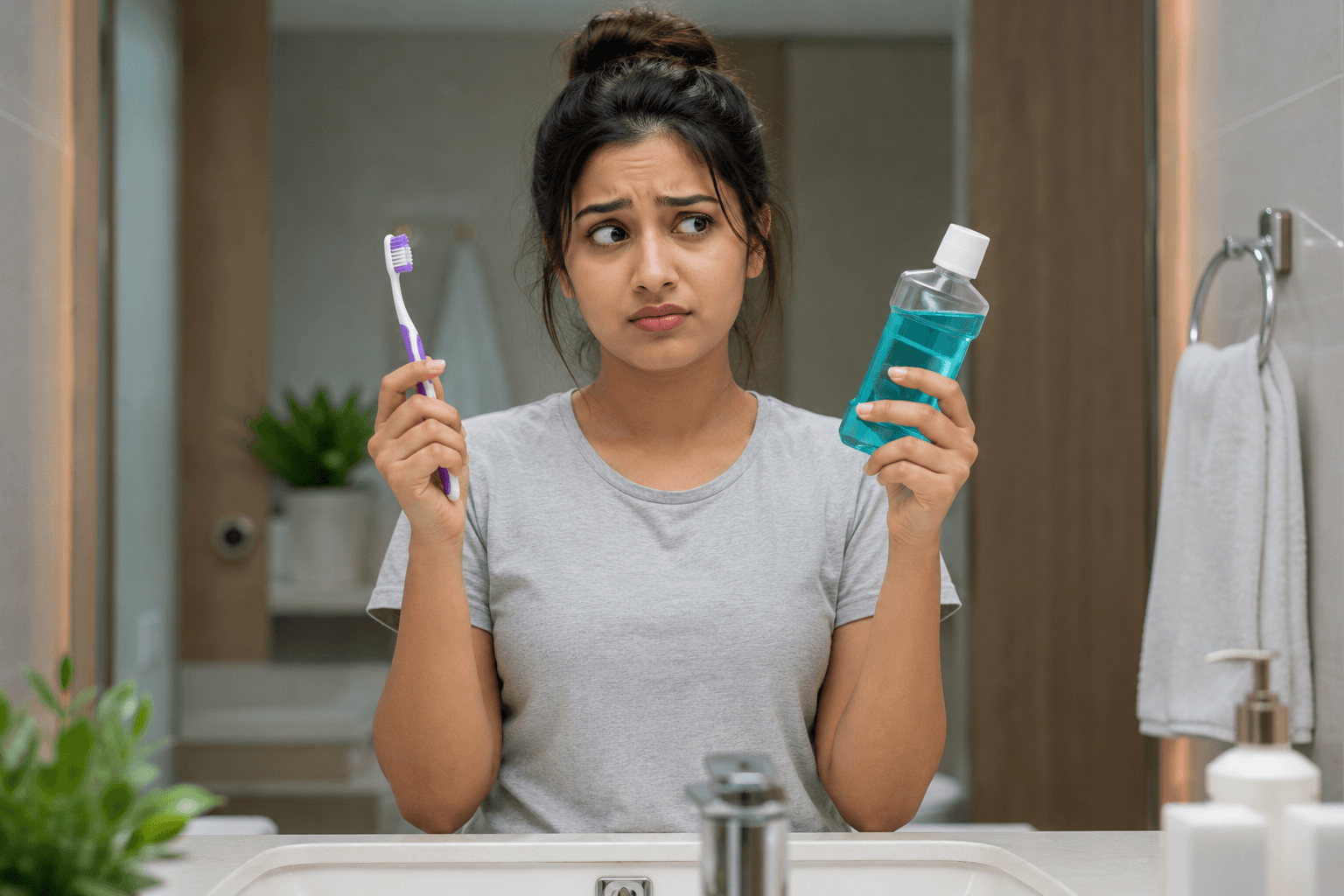
It’s 11 p.m., you’ve just got back from a late dinner at a restaurant near Marine Drive, and your toothbrush feels like it’s a whole floor away. The mouthwash bottle on the shelf, though, is right there. One swig, one swish, and surely that counts for something?
It does, just not what most people hope it counts for. If you’ve ever wondered whether a capful of mouthwash can stand in for two minutes with a toothbrush, the honest answer from dentistry is no, and the reason has less to do with tradition and more to do with basic mechanics.
Brushing Does a Job Mouthwash Physically Cannot
Plaque isn’t a stain sitting on top of your teeth. It’s a living film of bacteria that glues itself to the tooth surface within hours of your last brush, and it keeps building layer by layer until something scrapes it off. That “something” has to be mechanical bristles moving against enamel, dislodging the film physically.
Mouthwash, no matter how strong the antiseptic, is a liquid. It swirls around the mouth and rinses away loose food debris and some surface bacteria, but it cannot scrub. Dental researchers describe this as the difference between a chemical intervention and a mechanical one, and only the mechanical one removes plaque that has already attached itself to enamel. Skip brushing for even a day or two, and that film calcifies into tartar, which no rinse, however medicated, can touch. At that point, only a professional scaling and polishing session removes it.
This is why every dentist across Kochi and Ernakulam who examines a “mouthwash-only” patient tends to spot the same signs early: a slightly rough, filmy texture along the gumline, especially behind the lower front teeth, where saliva concentrates minerals and tartar forms fastest.
Where Mouthwash Actually Earns Its Place
None of this makes mouthwash useless; it just means its job is narrower than the bottle’s marketing suggests. A good rinse is genuinely effective at three things: temporarily reducing the bacterial count in saliva, delivering fluoride or antimicrobial agents to areas a brush might skim past, and providing short-term relief from bad breath after meals like fish curry or garlic-heavy fried food, both Kochi kitchen staples.
Chlorhexidine rinses, prescribed after certain gum surgeries or deep cleanings, do real clinical work, but even then, they’re a supplement to a recovery routine, not a substitute for the brushing that resumes once healing allows. Fluoride rinses can add a layer of enamel protection, particularly useful for people prone to cavities between teeth. And for people managing gum sensitivity after a cleaning, an alcohol-free rinse feels less harsh than brushing that area directly for a day or two again, a short bridge, not a long-term swap.
One point worth flagging for anyone using mouthwash daily out of habit: rinses with high alcohol content can dry out the mouth over time. Saliva is one of the body’s own defenses against bacteria, so a chronically dry mouth from alcohol-based rinsing can, ironically, make bad breath and bacterial buildup worse rather than better the opposite of what most people are reaching for the bottle to fix.
What a Genuinely Complete Routine Looks Like
Dental associations worldwide converge on largely the same basics, and they hold up whether you’re in Kaloor or Kakkanad:
- Brush twice daily for two full minutes with a soft-bristled brush and fluoride toothpaste, angled gently along the gumline, not just across the chewing surfaces.
- Floss once a day. This is the step most people skip, and it’s the one that removes plaque from between teeth the exact spot where a toothbrush’s bristles can’t reach and where a large share of cavities begin.
- Use mouthwash as an add-on after brushing and flossing, not instead of them, choosing a fluoride or antibacterial rinse suited to your specific need rather than whichever bottle is on sale.
- Get a professional cleaning every six months. Even a flawless home routine leaves behind some tartar buildup that only a dental scaler can remove, and a routine check-up costs far less typically a few hundred to around a thousand rupees at most clinics in the city than a full tooth decay and cavity treatment later.
Think of the three tools this way: the toothbrush removes what’s stuck on, floss removes what’s wedged between, and mouthwash rinses what’s left loose. Remove any one leg of that stool and the other two end up doing more work than they’re built for.
The Real Risk of Skipping Brushing for Mouthwash
The consequence isn’t abstract. Plaque left undisturbed for a few days starts irritating the gumline, leading to the puffiness and occasional bleeding that mark early gingivitis. Left longer, it hardens into tartar, which traps more bacteria and pushes gum disease further along a process that, over months, can progress toward the bone loss seen in periodontitis, one of the more common concerns our dental care team sees in patients who put off check-ups. None of this happens with a single skipped brushing, but a mouthwash-instead-of-brushing habit, sustained over weeks, adds up quietly until a dental visit reveals just how much.
The good news is that reversing course is straightforward. There’s no damage done by an occasional missed brush that a return to a proper routine won’t undo; the mouth is forgiving as long as the basics resume.
FAQs
1. Can I use mouthwash instead of brushing if I’m in a hurry? No. Mouthwash rinses away loose particles and reduces bacteria temporarily, but it can’t remove the plaque already stuck to your teeth. If you’re truly short on time, even a 30-second brush with plain water is more effective than a full minute of rinsing.
2. Is it safe to use mouthwash every day? Yes, for most people, daily use of an alcohol-free or fluoride mouthwash is safe and can support oral hygiene. Frequent use of high-alcohol rinses, though, can dry out the mouth over time, so it’s worth checking the label or asking your dentist which type suits you.
3. Does mouthwash help with bad breath permanently? Only temporarily. Mouthwash masks odour by killing some bacteria and adding fragrance, but bad breath usually returns within a few hours because the underlying cause — plaque, food debris, or sometimes gum issues hasn’t been addressed. Persistent bad breath is worth mentioning at your next dental check-up.
4. Should I use mouthwash before or after brushing? Most dentists recommend using it after brushing and flossing, so it rinses away what’s been loosened rather than coating a still-dirty tooth surface. Some fluoride rinses are best used at a separate time of day so the fluoride isn’t immediately washed away.
5. Can children use mouthwash instead of brushing? No, and mouthwash generally isn’t recommended for young children at all unless a dentist specifically advises it, since they’re more likely to swallow it. Brushing with a pea-sized amount of fluoride toothpaste, supervised, remains the standard. Our pediatric dental care team can advise on the right routine and timing for your child’s age.
Noticing signs of plaque buildup, gum sensitivity, or just due for a check-up? Book a consultation with our dental team at Novocare, Edappally, Kochi. You can also read our guide on how to choose the right dental clinic in Kochi for what to look for in ongoing care.